
WHAT TYPE OF YOGA DO WE TEACH?
We teach a traditional form of yoga that reconnects with the discipline’s original roots. As a Certified Yoga Instructor Organization, we fully align with the interpretation provided by the Hungarian Yoga Instructors’ Association.
We understand yoga as an ancient, practice-based universal philosophical system originating from India that supports the physical, mental, spiritual, social and existential development of the individual. Its ultimate aim is enlightenment and the attainment of complete mastery over the mind. In this state the individual soul recognises its unity with the Higher Self and its inherent divine nature.
The aim of experiencing this deepest human potential is not part of any religious process. Yoga is a discipline of self-inquiry and experiential self-observation. While religions seek to define what one should believe, a practical science such as yoga, including meditation, is grounded in the concrete experiences of teachers and yogis who have applied these techniques. Yoga does not contradict any religion and can be practised by anyone, regardless of whether they consider themselves religious or affiliated with any faith tradition.
Yoga is the science of the body, the mind and the spirit. Through its thousands-year-old practices and philosophy, it helps people in every era return to the path of harmony, health and genuine well-being.

Hanuman, the Inspiration Behind Our Name
“Hanuman teaches us that there is only one force capable of overcoming our doubts and fears.
That force is love.”

The Story of Hanuman
Anjana was a beautiful woman who longed deeply for motherhood, so she prayed every day for the blessing of a child. Vayu, the god of the wind, admired her greatly, and when he heard her prayer he decided to help. He blessed a few grains of rice and sent them to her with the help of his bird friends who happened to be passing by. Anjana was immersed in her daily prayer. She raised her hands high in anjali mudra, ready to receive the divine blessing. Instead of a vision or a sign, she received a few grains of rice. She was wise enough not to question the form her prayer took, so she opened her mouth and swallowed the rice. By accepting the blessed grains, she became pregnant.
When Anjaneya, “the son of Anjana,” was born, he came into the world with a fiery and impulsive nature. He was half mortal and half immortal, for Vayu was his father. This divine lineage often drew him into trouble. One morning, as young Anjaneya woke, he believed he saw a magnificent mango crossing the sky. Since mangoes were his favourite food, he immediately leapt into the heavens and chased after it. What he failed to notice was that the “mango” was in fact the sun. When Surya, the sun god, realised that this mischievous child was rushing toward him with the intention of taking a bite, he sent a lightning bolt to stop him. The strike hit the boy’s jaw, killing him instantly, and Anjaneya fell back to earth.
When Vayu learned what Surya had done, he drew in a breath of furious magnitude. It was so deep that he pulled all the air from the earth, and living beings began to suffocate. The gods convened an emergency council to appease both Vayu and Surya and to restore balance. Vayu refused to exhale until his son, Anjaneya, was returned to him. Surya, however, did not wish to see this unpredictable child roaming the world without restraint.
In the end, an agreement was reached. Anjaneya was given a new name, Hanuman, a reference to the broken jaw caused by the lightning strike (the Sanskrit word hanuh means “jaw”). He was brought back to life, but afflicted with short-term memory so that he would never remember his divine nature long enough to cause serious harm. If he believes himself to be a simple mortal, what trouble could he possibly create?
He was eventually separated from his mother so he could begin a new life. He was entrusted to Sugriva, the dependable monkey king, and the boy took on a monkey form to better integrate into his new family.
Hanuman became an indispensable warrior of the proud monkey tribe. One day, while walking through the forest, he met King Rama. The connection between them was immediate. Hanuman swore his loyalty to Rama on the spot, vowing never to leave his side. Rama welcomed him into his inner circle, and the two became inseparable, like a seed and its pod.
Rama’s wife, Sita, was renowned for her beauty and divine qualities. It did not take long for the evil demon Ravana to become overwhelmingly jealous of the couple. His envy clouded his judgment, and he attacked Rama’s kingdom, abducting Princess Sita and taking her to his island, Lanka.* Rama’s duty was to protect his realm, so he could not immediately set out after his beloved Sita. Instead, he sent his loyal friend Hanuman to rescue her.
Hanuman set out across the subcontinent without the slightest idea of how he would accomplish his mission, yet he knew he had no other choice. His pure love for his dearest friend dissolved every doubt he held about his own abilities. When he reached the seashore and looked out over the vast and endless ocean that separated him from Lanka, he knelt down to pray. The posture in which he knelt — one knee raised, the other folded beside him — later inspired the original virasana, the hero pose. He closed his eyes and prayed for the grace that would enable him to achieve the impossible. Throughout his prayer his trust remained unshaken. When he felt he had gathered enough strength, he pressed his foot firmly into the ground, creating a shockwave so powerful that it flattened the trees and mountains behind him. He rose into the sky and soared toward Lanka over the open sea.

The Devoted Hero
It is essential to recognise that when Hanuman knelt to pray for the strength to accomplish the impossible, he was already capable of reaching his goal. As the son of the Wind God, Hanuman could do anything. He could grow to an immense size or shrink to the tiniest form, move mountains or even transform his entire appearance. Yet he constantly forgot his own divinity, so he turned to his faith — known in Sanskrit as shraddha — to restore the confidence he needed to fulfil his duty. Many of us falter before tasks that seem impossible, or even before those that are simply challenging, because we resemble Hanuman in this way. We easily forget that we, too, carry a divine spark and are capable of achieving what appears unattainable. We also forget the power of shraddha, a force rooted in every human heart.
Throughout history, some form of prayer has always existed, offering people the space and time needed for faith to grow within their hearts. Faith and hope are what enable us to move forward with confidence, to leap across an ocean, to change the world or simply to dare to fall in love again.
Soaring Toward New Heights
As Hanuman flew across the ocean toward his destiny, he extended one leg forward and the other behind him in the famous split posture that yoga practitioners today know as hanumanasana.

Despite the many obstacles he faced along the way — including being swallowed by a sea-dwelling demon — Hanuman finally reached Lanka. He searched tirelessly until he found Sita in the garden of Ravana’s palace. There he transformed himself into a cat so he could approach her unnoticed and tell her that Rama would soon come to rescue her. Sita gave him one of her hairpins so Rama could be certain that she had been found, and Hanuman gave her Rama’s ring to assure her of the rescue to come. In the end, Sita was freed. Rama brought the battle to Ravana’s gates and, with Hanuman’s help, defeated the demon king and liberated his beloved wife.
When balance and peace were finally restored, Rama held a grand celebration in his palace, with Hanuman as the guest of honour. The hero was formally recognised, and Rama presented him with his own gold bracelet, studded with precious gems. The sight of the divine gift left the crowd breathless with admiration and pride, yet Hanuman simply stared at the bracelet. He tapped it, then bit into it. When a few of the gemstones fell out, he examined the gold even more closely. He appeared dissatisfied, as though he had not found what he was seeking. Rama, Sita and all who witnessed the scene were astonished by what seemed like Hanuman’s ingratitude. Eventually Rama asked him why he did not seem happy with the gift.
Hanuman looked at him and said, “Rama, I repeat your name every moment. I repeat it constantly so that I never forget how deeply I love you. I repeat it so often that your name is written on the very muscles of my heart. This bracelet has no value to me if it does not carry your name. Here, look for yourself.” Hanuman knelt before Sita and Rama, pressed his fingers into his chest and opened it to reveal what lay inside. There, within him, were the perfect forms of Rama and Sita, and on every fibre of his heart muscle Rama’s name was inscribed. With every beat, a soft chant could be heard: “Rama, Rama.
Hanuman’s journey, as described in detail in the Ramayana, stands as a model of faith, fearlessness and complete devotion. He embodies every quality of the yogi, and in many ways his story mirrors our own. How often have we forgotten our divine nature and slipped once more into the same self-limiting patterns of thought? Who has not experienced a crisis of faith and felt that a burden was too heavy to carry? Who has not faced a task that seemed utterly impossible? Hanuman teaches us that only one force has the power to overcome our doubts and fears, and that force is love.
At the heart of the bhakti yoga** tradition lies the cultivation of this very quality: a practice so deep that it dissolves all fear and doubt, leaving nothing but the remembrance of our true nature. The central tool of bhakti yoga is the mantra, or the repetition of a short sacred word that fixes our attention on the object of devotion. For Hanuman, this object was Rama, whose name he repeated constantly. Although his short memory often caused him to forget his tasks or even his relationships, he never forgot his dearest friend. Every sentence began and ended with Rama’s name. In his spare moments he repeated it without interruption. In time, every particle of his being vibrated with Rama’s name, and through perfect concentration his soul merged with the one to whom his devotion was offered. He himself became the embodiment of love, and that is why Rama and Sita made their home in his heart.
Many yoga practitioners discover that the power of mantra brings deep and joyful feelings to the surface. Whether one is listening to mantra chanting or taking part in kirtan — the call-and-response form of devotional singing — the effect of repetition is easy to feel. These practices are closely related to japa, a more inward form of repetition used in many yoga traditions as a tool for meditation. A mantra may be spoken aloud, sung melodically or repeated silently within. Its purpose is to free us from the fears and illusions that hold us back from realising our full potential. The word mantra comes from manas (mind) and trāyate (liberation), meaning “that which frees the mind.” Progress on the yogic path rests on the consistency of repetition. When practice becomes continuous, fear inevitably dissolves, and the state of complete devotion becomes attainable — just as Hanuman demonstrated.
* The original source, the Ramayana, does not recount the story in this form, but I will not amend it here due to the nature of the translation.
** “The yoga of divine love (bhakti yoga) is the process through which a person revives their dormant love for God by engaging in active service, deep meditation and the chanting of God’s sacred names. Through this, one fully realises their spiritual nature and their relationship with the Supreme Person, the Divine. At the level of bhakti, or devotional love, one places God’s will and God’s service at the very centre of their life.”
Translated into Hungarian by: Dr. Emese Onozó, Yoga Instructor
Reviewed in Hungarian by: Beáta Hári
Source: Alanna Kaivalya, Arjuna van der Kooij, Sharon Gannon – Myths of the Asanas: The Stories at the Heart of the Yoga Tradition. Mandala Publishing, 2010, p. 77.
www.facebook.com/EperJOGAfoldje – with permission
OUR MASTERS
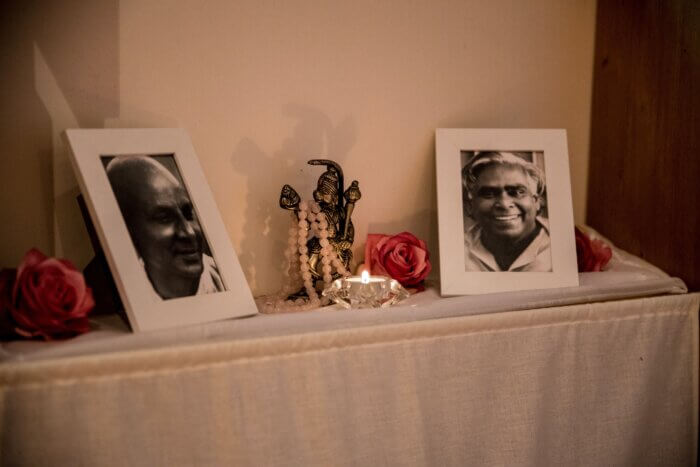
Some of our instructors obtained their yoga teacher certification at the Sivananda Yoga Centre (sivananda.hu), and we remain deeply and gratefully connected to this tradition, as well as to all classical yoga lineages that align with the understanding of yoga upheld by the Hungarian yoga community.


JÓGATERMÜNK



 English
  Magyar

